
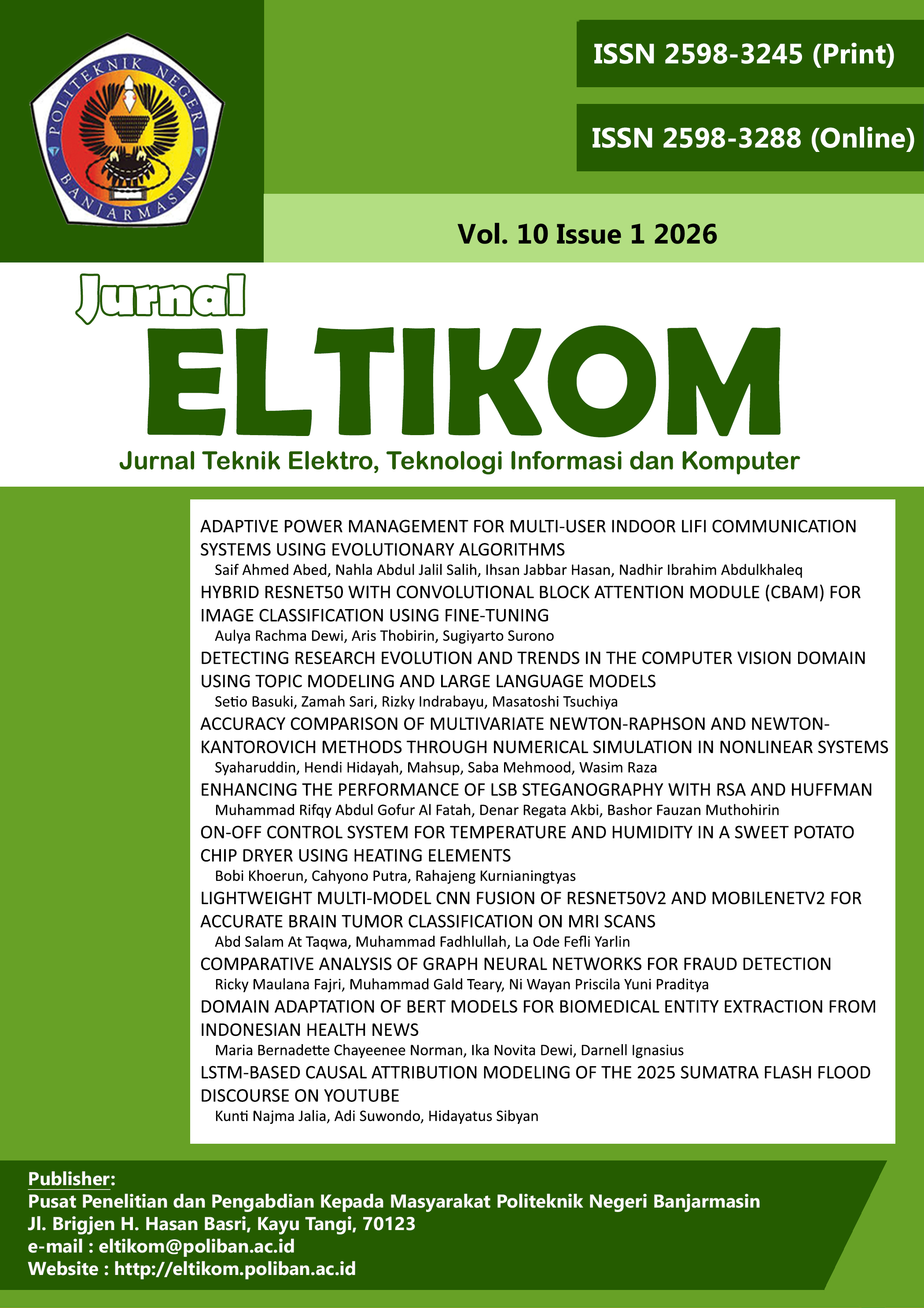
Accuracy Comparison of Multivariate Newton-Raphson and Newton-Kantorovich Methods through Numerical Simulation in Nonlinear Systems
DOI:
https://doi.org/10.31961/eltikom.v10i1.1971Keywords:
multivariate newton-raphson, newton-kantorovich, nonlinear systems of equations, numerical methodsAbstract
Nonlinear systems of equations often appear in various fields of science and generally cannot be solved analytically, so numerical methods are required. However, previous studies have not provided a direct comparison of the accuracy and efficiency of the Multivariate Newton-Raphson method and the Newton-Kantorovich method when applied to the same nonlinear system, creating a gap in understanding their relative performance. This study aims to analyze and compare the performance of two numerical methods, namely the Newton-Raphson method and the Newton-Kantorovich method, in solving nonlinear systems of equations numerically. The evaluation is based on the convergence rate, result accuracy, and iteration efficiency of each method. The nonlinear system used involves trigonometric, exponential, and polynomial functions. Simulations were conducted twice using three equations directly for each method. The error tolerance was set at 0.001, with a maximum of 100 iterations. The simulation results showed that the Multivariate Newton-Raphson method had the best performance, requiring only 7 iterations to achieve convergence with a very small error of 2.711×10^(-7). In contrast, the Newton-Kantorovich method required 21 iterations and produced an error of 6.770×10^(-5), indicating slower convergence and lower efficiency. Based on these results, it can be concluded that the Multivariate Newton-Raphson method is the more accurate and efficient method for solving nonlinear systems of equations through numerical simulation. This finding contributes to the selection of an appropriate numerical method and opens opportunities for further exploration in higher-dimensional systems.
Downloads
References
[1] M. Shakeel, S. T. Mohyud-Din, and M. A. Iqbal, “Modified extended exp-function method for a system of nonlinear partial differential equations defined by seismic sea waves,” Pramana - J. Phys., vol. 91, no. 2, pp. 1–8, 2018.
[2] V. Torkashvand, “A two-step method adaptive with memory with eighth-order for solving nonlinear equations and its dynamic,” Comput. Methods Differ. Equations, vol. 10, no. 4, pp. 1007–1026, 2022.
[3] J. Ríos-Ocampo and M. S. Gary, “Using analytical equations to represent nonlinear relationships,” Syst. Dyn. Rev., vol. 38, no. 4, pp. 354–370, 2022.
[4] L. Zakaria, A. Eka, and D. Aziz, “Penyelesaian Sistem Persamaan Fully Fuzzy Non Linear Menggunakan Metode Newton Raphson Ganda,” J. Math. Theory Appl., vol. 5, no. 2, pp. 67–73, 2023.
[5] P. Batarius, J. San Juan, and P. Kupang, “Perbandingan Metode Newton-Raphson Modifikasi Dan Metode Secant Modifikasi Dalam Penentuan Akar Persamaan,” Semin. Nas. Ris. dan Teknol. Terap., vol. 8, no. Ritektra 8, pp. 53–63, 2018.
[6] E. Sunandar and I. Indrianto, “Perbandingan Metode Newton-Raphson & Metode Secant Untuk Mencari Akar Persamaan Dalam Sistem Persamaan Non-Linier,” J. Pengkaj. dan Penerapan Tek. Inform., vol. 13, no. 1, pp. 72–79, 2020.
[7] F. Ahmad, “Multi-step derivative-free preconditioned Newton method for solving systems of nonlinear equations,” SeMA J., vol. 75, no. 1, pp. 45–56, 2018.
[8] M. Adriana, “on the Convergence of the Newton-Raphson Method and Some of Its Generalizations,” Bull. Transilv. Univ. Brasov, Ser. III Math. Comput. Sci., vol. 4, no. 2, pp. 215–224, 2024.
[9] M. Putri and S. Syaharuddin, “Implementations of Open and Closed Method Numerically: A Non-linear Equations Solution Convergence Test,” IJECA (International J. Educ. Curric. Appl., vol. 2, no. 2, p. 1, 2019.
[10] Inderjeet and R. Bhardwaj, “A new Iterative Newton Raphson technique for the numerical simulation of Nonlinear Equations,” J. Integr. Sci. Technol., vol. 13, no. 4, pp. 1–6, 2025.
[11] M. Mohammad Ali, “Numerical differential continuation approach for systems of nonlinear equations with singular Jacobian,” AUT J. Math. Comput., vol. 3, no. 1, pp. 53–58, 2022.
[12] Y. Liao and L. Cui, “Newton Like Iterative Method without Derivative for Solving Nonlinear Equations Based on Dynamical Systems,” J. Res. Sci. Eng., vol. 5, no. 5, pp. 1–7, 2023.
[13] A. Hasanudin, “Calculation of Loan Amount When Cooperatives Do Not Make Profits with Non-Linear Equation Method Using Secant and Its Implementation with MATLAB,” J. Penelit. Mat. dan Pendidik. Mat., vol. 8, no. 1, pp. 17–22, 2023.
[14] S. Regmi, I. K. Argyros, S. George, and M. I. Argyros, “A Comparison Study of the Classical and Modern Results of Semi-Local Convergence of Newton–Kantorovich Iterations-II,” Mathematics, vol. 10, no. 11, pp. 1–14, 2022.
[15] Yudhi, Devitriani, Mariatul Kiftiah, “Analisis Metode Newton-Raphson Ganda Orde Konvergensi Empat Dalam Menyelesaikan Sistem Persamaan Nonlinear,” Bimaster Bul. Ilm. Mat. Stat. dan Ter., vol. 8, no. 2, pp. 213–220, 2019.
[16] J. R. Sharma and H. Arora, “Improved Newton-like methods for solving systems of nonlinear equations,” SeMA J., vol. 74, no. 2, pp. 147–163, 2017.
[17] O. Paulina Maure and H. Tulan, “Studi Komparasi Beberapa Metode Numerik Dalam Mengaproksimasi Akar-Akar Persamaan Non Linear,” Asimtot J. Kependidikan Mat., vol. 6, no. 01, pp. 1–12, 2024.
[18] J. Lacotte and M. Pilanci, “Adaptive and Oblivious Randomized Subspace Methods for High-Dimensional Optimization: Sharp Analysis and Lower Bounds,” IEEE Trans. Inf. Theory, vol. 68, no. 5, pp. 3281–3303, 2022.
[19] M. Farman, A. Akgül, N. Alshaikh, M. Azeem, and J. Asad, “Fractional-Order Newton–Raphson Method for Nonlinear Equation With Convergence and Stability Analyses,” Fractals, vol. 31, no. 10, pp. 1–12, 2023.
[20] L. F. Grisales-Noreña, O. D. Montoya, W. J. Gil-González, A. J. Perea-Moreno, and M. A. Perea-Moreno, “A comparative study on power flow methods for direct-current networks considering processing time and numerical convergence errors,” Electron., vol. 9, no. 12, pp. 1–20, 2020.
[21] H. Okawa et al., “The W4 method: A new multi-dimensional root-finding scheme for nonlinear systems of equations,” Appl. Numer. Math., vol. 183, no. 1, pp. 157–172, 2023.
[22] S. Regmi, I. K. Argyros, S. George, and M. I. Argyros, “Developments on the Convergence Analysis of Newton-Kantorovich Method for Solving Nonlinear Equations,” Eur. J. Math. Anal., vol. 3, no. 11, p. 15, 2023.
[23] S. Regmi, I. K. Argyros, S. George, and J. Warden, “A Unified Kantorovich-type Convergence Analysis of Newton-like Methods for Solving Generalized Equations under the Aubin Property,” Eur. J. Math. Anal., vol. 4, no. 9, p. 3, 2024.
[24] A. G. Kamel, E. H. Haraz, and S. N. Hanna, “Numerical Simulation of Channel Flow Over a Skewed Equilateral Cavity,” J. Appl. Math. Comput. Mech., vol. 19, no. 3, pp. 29–43, 2020.
[25] N. K. Vitanov, “Simple Equations Method (SEsM): An Effective Algorithm for Obtaining Exact Solutions of Nonlinear Differential Equations,” Entropy, vol. 24, no. 11, pp. 1–55, 2022.
[26] I. K. Argyros, S. George, S. Shakhno, S. Regmi, M. Havdiak, and M. I. Argyros, “Asymptotically Newton-Type Methods without Inverses for Solving Equations,” Mathematics, vol. 12, no. 7, pp. 1–19, 2024.
[27] R. A. Isewid, “An Enhanced Newton-Kantorovich Technique for Nonlinear Problem-solvers to Optimal Control Convergence,” Al-Qadisiyah J. Pure Sci., vol. 29, no. 20, pp. 131–140, 2024.
[28] E. Weinan, J. Han, and A. Jentzen, “Deep Learning-Based Numerical Methods for High-Dimensional Parabolic Partial Differential Equations and Backward Stochastic Differential Equations,” Commun. Math. Stat., vol. 5, no. 4, pp. 349–380, 2017.
[29] H. Ali, T. Datta, and M. Kamrujjaman, “Efficient Family of Iterative Methods for Solving Nonlinear Simultaneous Equations: A Comparative Study,” J. Appl. Math. Comput., vol. 5, no. 4, pp. 331–337, 2021.
[30] H. A. H. Abugirda, K. S. Al-Yasiri, and M. K. Abdullah, “Newton-Kantorovich Method for Solving One of the Non-Linear Sturm-Liouville Problems,” Baghdad Sci. J., vol. 20, no. 3, pp. 2036–2041, 2023.
[31] A. Ivanov, “On transversal connecting orbits of Lagrangian systems in non-stationary force field: Newton-Kantorovich approach,” IEEE Technol. a Sustain. Clim. Collect., vol. 26, no. 392, pp. 1–27, 2019.
[32] Ľ. Baňas and S. Herr, “Numerical approximation of bi-harmonic wave maps into spheres,” SIAM J. Numer. Anal., vol. 63, no. 3, pp. 1–20, 2025.
[33] E. Berglund, S. Khirirat, and X. Wang, “Zeroth-Order Randomized Subspace Newton Methods,” u IEEE Int. Conf. Acoust. Speech Signal Process., vol. 9, no. 4, pp. 1–9, 2022.
[34] I. K. Argyros, S. Regmi, S. Shakhno, and H. Yarmola, “A Methodology for Obtaining the Different Convergence Orders of Numerical Method under Weaker Conditions,” Mathematics, vol. 10, no. 16, pp. 19–21, 2022.
Downloads
Published
Issue
Section
License
Copyright (c) 2026 Syaharuddin, Hendi Hidayah, Mahsup Mahsup, Saba Mehmood, Wasim Raza

This work is licensed under a Creative Commons Attribution 4.0 International License.
All accepted papers will be published under a Creative Commons Attribution 4.0 International (CC BY 4.0) License. Authors retain copyright and grant the journal right of first publication. CC-BY Licenced means lets others to Share (copy and redistribute the material in any medium or format) and Adapt (remix, transform, and build upon the material for any purpose, even commercially).