
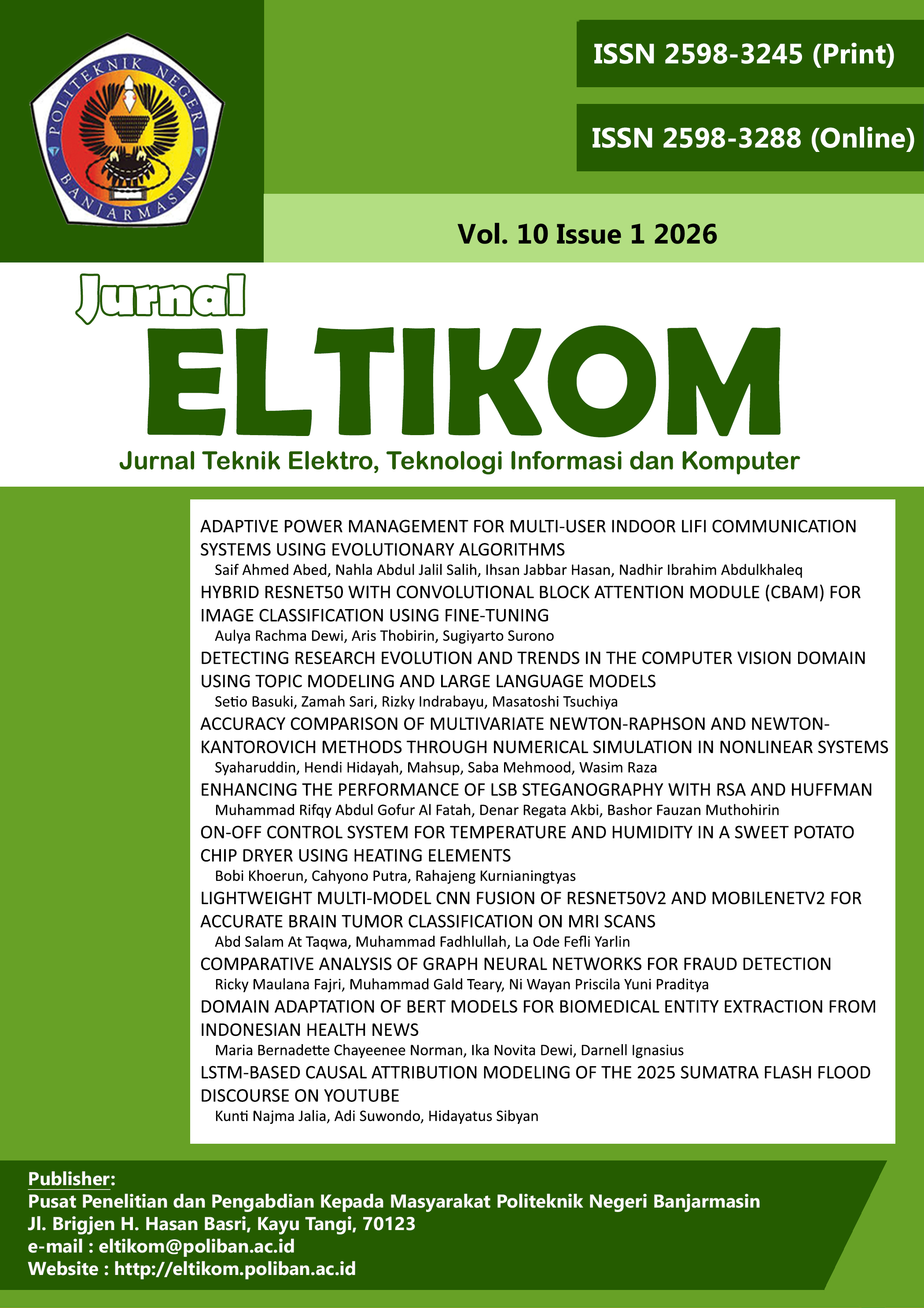
Comparative Analysis of Graph Neural Networks for Fraud Detection
DOI:
https://doi.org/10.31961/93y6ve52Keywords:
Fraud Analysis, Graph Neural Network, Imbalanced Dataset, SMOTEAbstract
Detecting financial fraud is a complex and evolving challenge, particularly because of the relational nature of transaction data, graph sparsity, and severe class imbalance. To the best of our knowledge, this study repre-sents one of the first systematic benchmarks of five prominent Graph Neural Network (GNN) architectures, GCN, GAT, GraphSAGE, GIN, and SGCN, for fraud detection under balanced and imbalanced conditions across multiple public datasets. We explicitly evaluate the impact of the Synthetic Minority Oversampling Technique (SMOTE) on graph-based fraud detection performance, an aspect that has rarely been addressed in prior research. The comparative analysis considers predictive performance (AUC, F1-Score, Precision, Re-call) and computational efficiency to provide actionable guidance for real-world development. The experimental results show that GraphSAGE offers the best trade-off between accuracy and execution time for laten-cy-sensitive environments, while GAT’s attention mechanism supports offline, interpretability-driven analysis. These findings provide empirical evidence to inform GNN selection strategies for scalable and effective fraud detection systems.
Downloads
References
[1] L. S. Goecks, A. L. Korzenowski, P. Gonçalves Terra Neto, D. L. de Souza, and T. Mareth, “Anti‐money laundering and financial fraud detection: A systematic literature review,” Intell. Syst. Accounting, Financ. Manag., vol. 29, no. 2, pp. 71–85, 2022.
[2] P. Chatterjee, D. Das, and D. B. Rawat, “Digital twin for credit card fraud detection: Opportunities, challenges, and fraud detection advancements,” Futur. Gener. Comput. Syst., vol. 158, pp. 410–426, 2024.
[3] P. Vanini, S. Rossi, E. Zvizdic, and T. Domenig, “Online payment fraud: from anomaly detection to risk management,” Financ. Innov., vol. 9, no. 1, p. 66, 2023.
[4] A. O. Adewumi and A. A. Akinyelu, “A survey of machine-learning and nature-inspired based credit card fraud detection techniques,” Int. J. Syst. Assur. Eng. Manag., vol. 8, no. Suppl 2, pp. 937–953, 2017.
[5] J. O. Awoyemi, A. O. Adetunmbi, and S. A. Oluwadare, “Credit card fraud detection using machine learning techniques: A comparative analysis,” in 2017 international conference on computing networking and informatics (ICCNI), IEEE, 2017, pp. 1–9.
[6] S. R. B. Reddy, P. Kanagala, P. Ravichandran, R. Pulimamidi, P. V Sivarambabu, and N. S. A. Polireddi, “Effective fraud detection in e-commerce: Leveraging machine learning and big data analytics,” Meas. Sensors, vol. 33, p. 101138, 2024.
[7] R. Bin Sulaiman, V. Schetinin, and P. Sant, “Review of machine learning approach on credit card fraud detection,” Human-Centric Intell. Syst., vol. 2, no. 1, pp. 55–68, 2022.
[8] G. Zhen and L. Jianpin, “TGFFD: A Two-Stream Graph Neural Network for Financial Fraud Detection Based on Graph Convolution and Wavelet Analysis,” in 2024 21st International Computer Conference on Wavelet Active Media Technology and Information Processing (ICCWAMTIP), IEEE, 2024, pp. 1–6.
[9] D. Wang et al., “A semi-supervised graph attentive network for financial fraud detection,” in 2019 IEEE international conference on data mining (ICDM), IEEE, 2019, pp. 598–607.
[10] D. Cheng, X. Wang, Y. Zhang, and L. Zhang, “Graph neural network for fraud detection via spatial-temporal attention,” IEEE Trans. Knowl. Data Eng., vol. 34, no. 8, pp. 3800–3813, 2020.
[11] M. M. Yadegar and H. Rahmani, “FinFD-GCN: Using Graph Convolutional Networks for Fraud Detection in Financial Data,” J. AI Data Min., vol. 12, no. 4, pp. 487–495, 2024.
[12] L. Lv, J. Cheng, N. Peng, M. Fan, D. Zhao, and J. Zhang, “Auto-encoder based graph convolutional networks for online financial anti-fraud,” in 2019 IEEE Conference on Computational Intelligence for Financial Engineering & Economics (CIFEr), IEEE, 2019, pp. 1–6.
[13] A. Cherif, H. Ammar, M. Kalkatawi, S. Alshehri, and A. Imine, “Encoder–decoder graph neural network for credit card fraud detection,” J. King Saud Univ. Inf. Sci., vol. 36, no. 3, p. 102003, 2024.
[14] R. Li, Z. Liu, Y. Ma, D. Yang, and S. Sun, “Internet financial fraud detection based on graph learning,” IEEE Trans. Comput. Soc. Syst., vol. 10, no. 3, pp. 1394–1401, 2022.
[15] T. N. Kipf and M. Welling, “Semi-supervised classification with graph convolutional networks,” arXiv Prepr. arXiv1609.02907, 2016.
[16] P. Veličković, G. Cucurull, A. Casanova, A. Romero, P. Lio, and Y. Bengio, “Graph attention networks,” arXiv Prepr. arXiv1710.10903, 2017.
[17] W. Hamilton, Z. Ying, and J. Leskovec, “Inductive representation learning on large graphs,” Adv. Neural Inf. Process. Syst., vol. 30, 2017.
[18] K. Xu, W. Hu, J. Leskovec, and S. Jegelka, “How powerful are graph neural networks?,” arXiv Prepr. arXiv1810.00826, 2018.
[19] F. Wu, A. Souza, T. Zhang, C. Fifty, T. Yu, and K. Weinberger, “Simplifying graph convolutional networks,” in International conference on machine learning, Pmlr, 2019, pp. 6861–6871.
[20] I. Syamsuddin, M. A. Hanafie, and Z. Sharuna, “AIZBank : Bank Dataset for Fraud Prediction,” Zenodo. [Online]. Available: https://zenodo.org/records/14636312
[21] V. Corporation, “IEEE-CIS Fraud Detection,” Kaggle. [Online]. Available: https://www.kaggle.com/competitions/ieee-fraud-detection
[22] E. Lopez-Rojas, A. Elmir, and S. Axelsson, “PaySim: A financial mobile money simulator for fraud detection,” in 28th European modeling and simulation symposium, EMSS, Larnaca, Dime University of Genoa, 2016, pp. 249–255.
[23] S. Jagtap, “Fraudulent E-Commerce Transactions Dataset,” Kaggle. [Online]. Available: https://www.kaggle.com/datasets/shriyashjagtap/fraudulent-e-commerce-transactions
[24] N. V Chawla, K. W. Bowyer, L. O. Hall, and W. P. Kegelmeyer, “SMOTE: synthetic minority over-sampling technique,” J. Artif. Intell. Res., vol. 16, pp. 321–357, 2002.
[25] A. Sakho, E. Scornet, and E. Malherbe, “Theoretical and experimental study of SMOTE: limitations and comparisons of rebalancing strategies,” arXiv Prepr. arXiv2402.03819, 2024.
[26] E. Süli and D. F. Mayers, An introduction to numerical analysis. Cambridge university press, 2003.
[27] X. Hu et al., “GAT-COBO: Cost-sensitive graph neural network for telecom fraud detection,” IEEE Trans. Big Data, vol. 10, no. 4, pp. 528–542, 2024.
[28] B. Wu, K.-M. Chao, and Y. Li, “Heterogeneous graph neural networks for fraud detection and explanation in supply chain finance,” Inf. Syst., vol. 121, p. 102335, 2024.
Downloads
Published
Issue
Section
License
Copyright (c) 2026 Ricky Maulana Fajri, Muhammad Gald Teary, Ni Wayan Pricila Yuni Praditya

This work is licensed under a Creative Commons Attribution 4.0 International License.
All accepted papers will be published under a Creative Commons Attribution 4.0 International (CC BY 4.0) License. Authors retain copyright and grant the journal right of first publication. CC-BY Licenced means lets others to Share (copy and redistribute the material in any medium or format) and Adapt (remix, transform, and build upon the material for any purpose, even commercially).